Analyse Crédit

Assess your suppliers' financial strength before you commit.

Upload your French supplier's tax return. Analyse Crédit delivers a committee memo rated 1 to 6, with every figure traced to its source and concrete levers for the buyer.

  • Forms 2050 to 2059 and 2033
  • French national business register

Ateliers Exemple SAS

Precision engineering · fiscal years 2022 to 2024

3/ 6 High risk

2024 revenue reached €18.4m, but EBITDA was only €1.1m and net cash is negative at €0.8m. Cap exposure and down payments at €250k until interim accounts are provided.

  • SolvencyGearing 1.4xWatch
  • ProfitabilityEBITDA margin 6.0%Watch
  • Liquidity and cycleNet cash −€0.8mDeteriorated
  • SignalsAccounts 14 months oldWatch
Fictitious company and figures from the demo file. Memos are written in French; excerpt translated.

The memo, in thirty seconds.

The film is in French.

A score is hard to defend in committee.

When a supplier becomes critical, the question is not only whether it might fail. You need to say what the buyer would lose, and how to protect against it. A rating without reasons does not answer that.

Credit scoreAnalyse Crédit memo
Data readAccounts filed with the commercial court. A small company's income statement can be kept confidential.The full tax return your supplier sends you, completed by the business register and its filed accounts.
What you getA score or a probability of default.A rating from 1 to 6, argued across four axes, with its alerts and levers.
JustificationA proprietary scoring model.Every figure points to its tax-return line or to the calculation that produced it.
Point of viewThe same for a lender, a customer or a buyer.The buyer's: continuity of supply, exposure, dual sourcing.
DeliverableAn online profile.A memo and a PDF ready for the meeting.

Under French rules, micro-companies may keep all their accounts confidential and small companies their income statement. Source: Infogreffe (in French).

From tax return to committee memo, in three steps.

  1. Upload the tax return

    As a PDF, even scanned, or as an Excel file. If you wish, add your purchasing context: exposure, down payments, tooling on loan.

    2050 to 20592033.pdf.xlsx
  2. The analysis reads, checks and calculates

    Amounts are copied as they are, the balance sheet is checked, ratios are calculated and every operation is logged. The national business register, filed accounts and news complete the file.

  3. You receive the memo

    A rating from 1 to 6, four axes, the alerts and up to three levers. The file stays in your account and exports to a PDF for the meeting.

The analysis keeps running if you close the tab: the file will be waiting for you.

An opinion you can defend, not a statement of accounts.

The memo is written for the buyer who presents a supplier to a committee: a short thesis, dated figures, quantified risks and what can be done about them.

Verdict

3/ 6 High risk

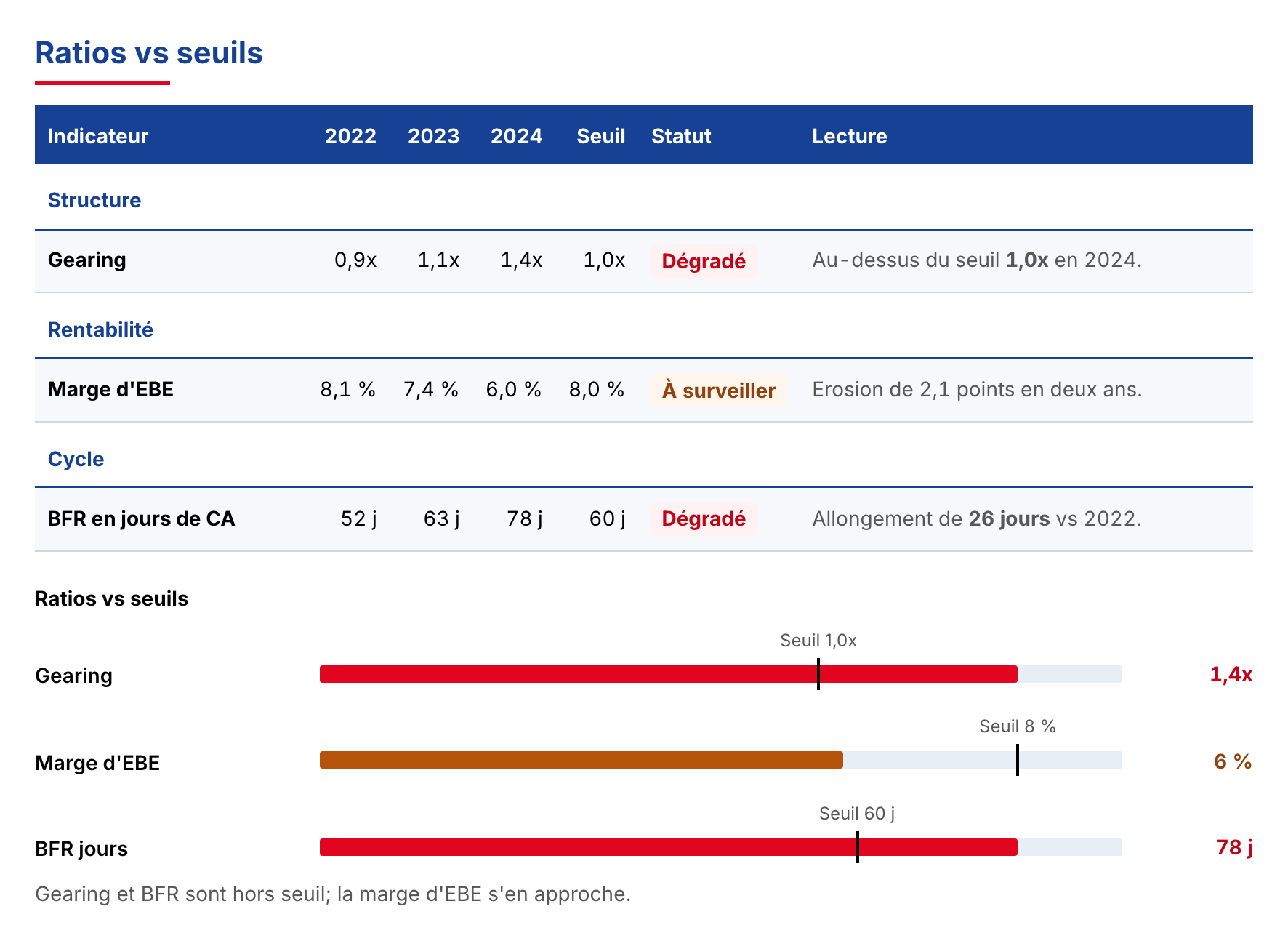
Negative net cash and working capital of 78 days weigh more on the buyer than a direct loss: the risk is a halt in deliveries.

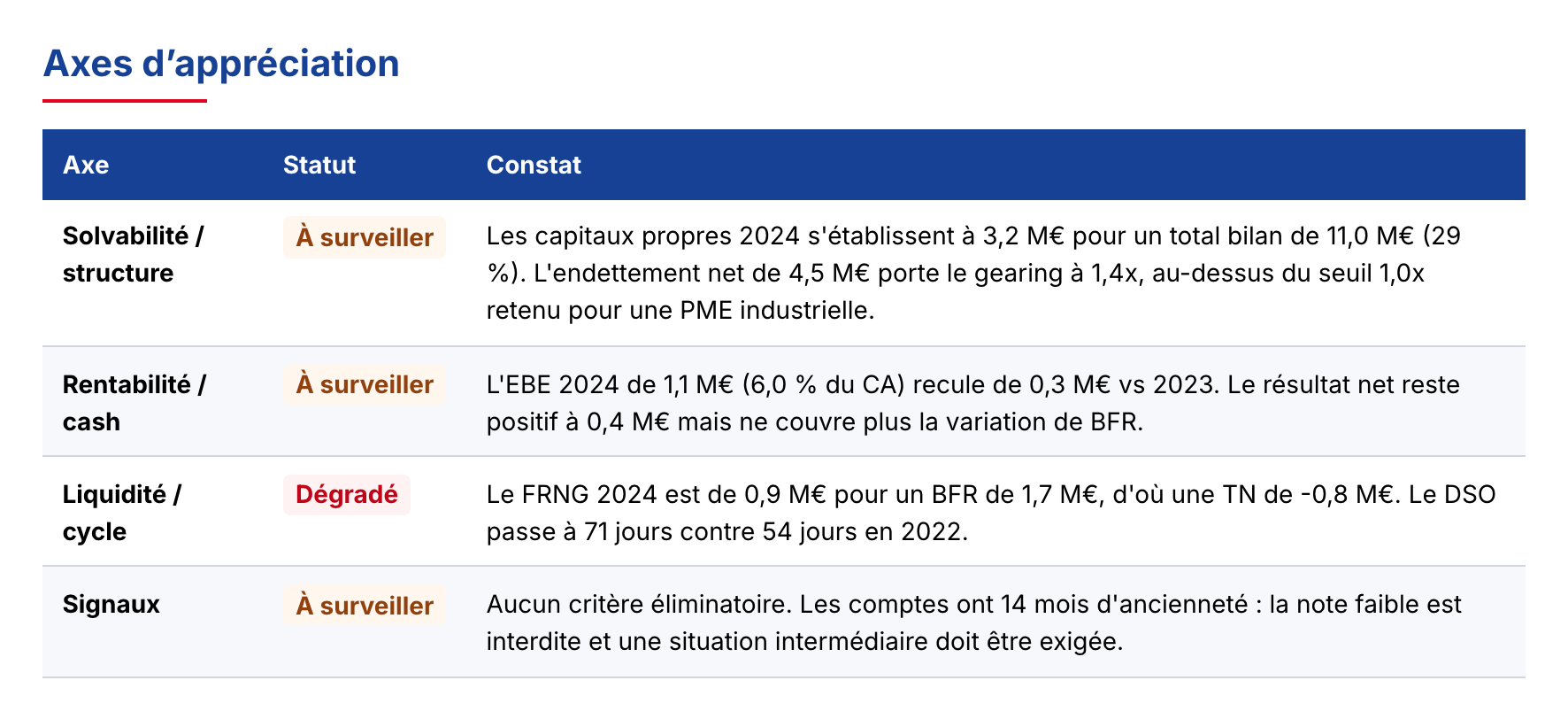
Assessment axes

SolvencyGearing 1.4x against a 1.0x thresholdWatch
Profitability2024 EBITDA: €1.1m, 6.0% of revenueWatch
Liquidity and cycleWorking capital €0.9m, requirement €1.7mDeteriorated
SignalsAccounts closed 14 months agoWatch

Alerts

Negative net cashTriggered

Losses over two years, negative equity, insolvency proceedingsNot triggered

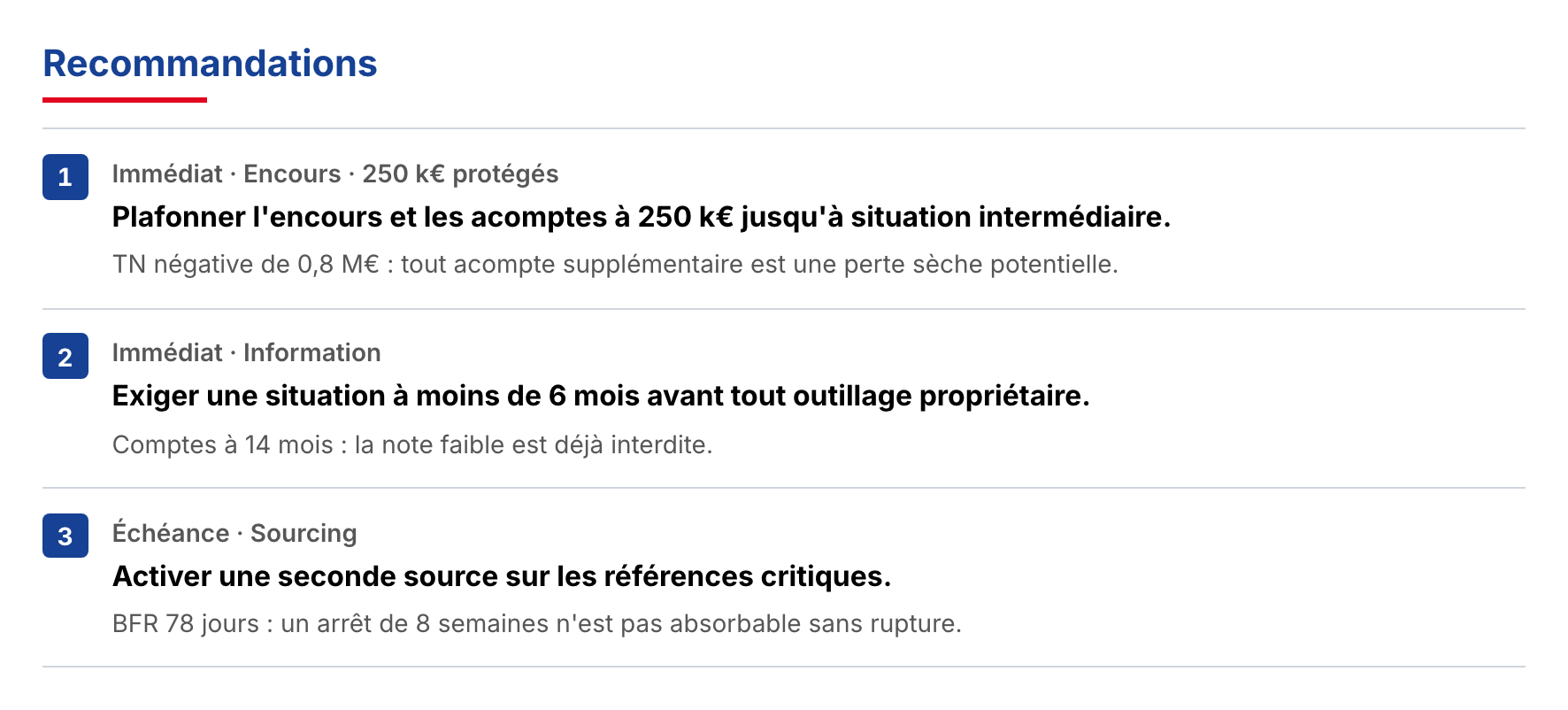
Recommendations

1Cap exposure and down payments at €250k until interim accounts are provided.Immediate · exposure · €250k protected
2Require accounts less than 6 months old before any proprietary tooling.Immediate · information
3Qualify a second source for critical parts.Medium term · sourcing
  1. A rating from 1 to 6, and why

    6 for a sound position, 1 for a supplier to avoid. The rating follows from the figures and from explicit floors: negative equity never scores better than 2.

  2. Four axes, one figure each

    Solvency, profitability, liquidity and signals: each axis carries its status and the figure that settles it, against a threshold.

  3. The alerts that matter to a buyer

    Repeated losses, negative cash, lengthening supplier payment terms, rising social and tax debts, insolvency proceedings: eight signals checked in every file.

  4. Levers you can act on

    Exposure cap, guarantee, dual sourcing, interim accounts. The memo informs the decision; it does not make it for you.

Every figure has a source.

An amount read on the tax return is copied, never adjusted. A ratio is calculated, and the operation is logged in the file. Select a figure to see where it comes from.

2024 revenue reached , but EBITDA was only , or of revenue. Net cash is negative at and gearing reaches . The chairman has been in office since .

Translated excerpt from the fictitious demo file.

Read on the tax return

€18.4m

Source
Form 2052, line FL: net revenue.
Handling
Amount copied without adjustment, in euros. A page stated in thousands of euros is converted before any calculation.
  • Total assets equal total liabilities
  • Balance-sheet result equals the income-statement result
  • Working capital minus requirement equals net cash
  • Cascade of intermediate management balances
  • Company identity checked in the register, never the signing firm's
  • Adversarial review of published figures against the calculation log

The tool, as your teams will use it.

Memo for Ateliers Exemple SAS: rating 3 out of 6, high risk, quantified thesis and report contents.

Screens from a fictitious demo file. The interface is in French.

For the decisions where the buyer commits.

  • Onboard a supplier

    Qualify its strength before the first contract, with an opinion added to the onboarding file.

  • Pay a deposit or lend tooling

    Measure the possible loss and set an exposure cap before advancing money or equipment.

  • Renew a contract

    Read the latest accounts to see what changed since the last tender.

  • Review critical suppliers

    Spot tightening cash or lengthening payment terms in time.

Frequently asked questions

Another question? Ask it during the demo.

Which documents are needed?

The supplier's French tax return (liasse fiscale): forms 2050 to 2059 under the standard regime, 2033 under the simplified regime. A PDF, even scanned, or an Excel file is enough. Notes and the statutory auditor's report enrich the analysis when attached.

In which language is the memo?

In French, like the interface: the method relies on the French chart of accounts (Plan comptable général) and French tax forms.

What if the supplier only sends one year?

Accounts filed with the register fill in the history when they exist. With a single usable year, the memo rates levels but not trends, and says so.

What if the accounts are old?

The rating grows more cautious as accounts age. Beyond 12 months, the top rating is no longer possible; beyond 18 months, the memo recommends requiring interim accounts; beyond 30 months, it reports insufficient information rather than rating.

Does the memo decide for me?

No. It gives a rating, its reasons and levers the buyer can act on. The commitment decision stays with your committee.

How much does it cost?

Pricing depends on how many suppliers you assess each year. We set it with you during the demo.

Request a demo

Leave your details and we will get back to you to arrange the demo.

  • A complete memo, from uploaded tax return to meeting PDF.
  • The source of every figure, from amount read to ratio calculated.
  • Where the tool fits in your supplier qualification process.
Please enter your name.
Please enter a valid email address.
Please enter your company.
This number does not look valid.